Company News
November 13, 2026
Inside Ginkgo's Autonomous Lab: What's Still Missing?
written by

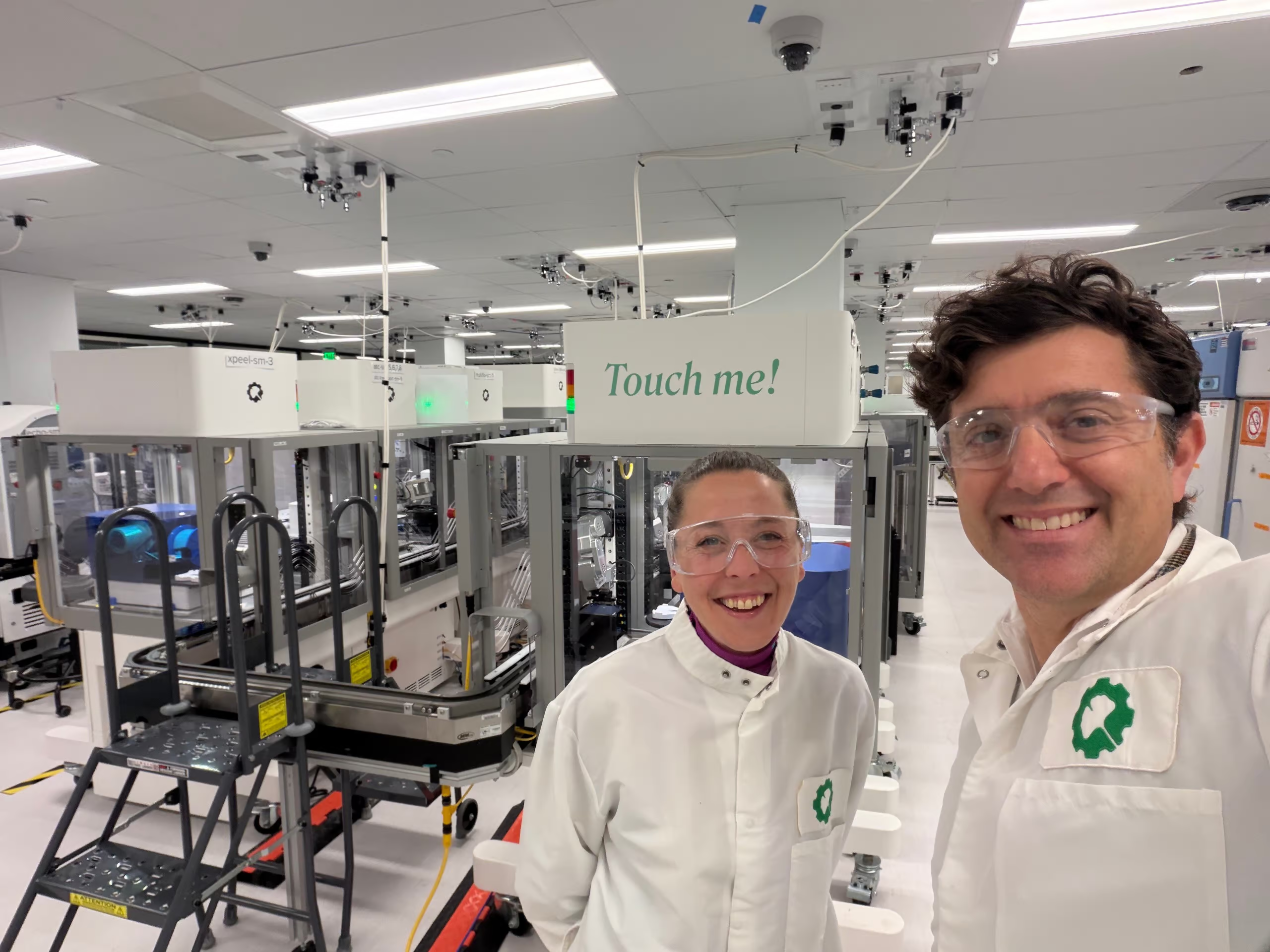
AI can now design experiments, instruct robots to run them and learn from the results. But who gets the reagents into the machines?
Last week, I visited Ginkgo Bioworks in Boston, where co-founder and CEO Jason Kelly gave me a tour of their autonomous laboratory.
Jason showed me how they're connecting AI with laboratory automation, including demonstrations of AI-generated protocols and experiments that can be executed and improved based on their results. It was amazing to see how far autonomous labs have come. But one of the most interesting parts of our conversation was about something much more fundamental: Who gets the reagents into the machines?
In February 2026, Ginkgo and OpenAI published research demonstrating an autonomous laboratory using GPT-5 to optimise cell-free protein synthesis.
The system tested more than 36,000 experimental conditions across six iterative cycles, reporting a 40% reduction in protein production costs compared with the previous state of the art, alongside increased protein yield.
Ginkgo has also launched its Cloud Lab, giving researchers remote access to automated laboratory infrastructure. These developments show how AI is beginning to connect experimental design, robotic execution and analysis into continuous learning cycles. But there's still a physical bottleneck.
Even when robots can execute complex protocols, people often still need to find reagents, check quantities, prepare materials and load them into instruments. In the Ginkgo–OpenAI study, human involvement included preparing, loading and unloading reagents and consumables, alongside system oversight. The faster we automate experimentation, the more important it becomes to automate everything that happens before it. At Openshelf, we call this Step 0: getting materials ready for automation.
At Openshelf, we're building an open, modular inventory platform that connects physical storage with laboratory software and automation. Our Oscar systems combine automated storage, barcode-based identification, inventory tracking and robotic retrieval. See Oscar in action.
We're also developing automation modules for cherry-picking, decapping and liquid transfer, extending Oscar's capabilities into material preparation. The goal is simple: Instead of someone finding a reagent, retrieving it, preparing it and loading it into a machine, we want to automate that entire process. See our automation modules in action.
Imagine an AI system deciding which experiment to run next, checking whether the required reagents are available, retrieving and preparing them, and initiating the experiment. But this raises another question. If we're already connecting storage, preparation and automation, why not rethink how the entire laboratory is organised?
I have a slightly nerdy obsession with the Frankfurt Kitchen. Anyone who has had to listen to me talk about it will know. And this year marks its 100th anniversary! In 1926, Austrian architect Margarete Schütte-Lihotzky designed the Frankfurt Kitchen, a small, carefully organised space that helped change how we think about kitchens.
Rather than simply adding better appliances, she reconsidered the entire process of cooking. Where should ingredients be stored? How far should someone have to move between preparing food, cooking and cleaning? How could storage, equipment and work surfaces become part of one connected workflow?
The result was one of the most influential designs in the history of the modern kitchen. Many ideas we now take for granted, from built-in storage to the arrangement of work surfaces and appliances, were shaped by this approach. And it all started by questioning how a kitchen should work. Jason also had to listen to my obsession, which brought us to an interesting question:
What if we approached laboratories in the same way?
A typical lab bench is full of smaller instruments: centrifuges, vortex mixers, shakers, heaters and other equipment needed to prepare, process and monitor materials. Today, we often automate individual instruments while keeping the laboratory layout largely unchanged. Samples still need to move between storage, benches and machines.
Jason and I discussed the idea of vertical labs: integrating these smaller processing and monitoring functions directly into a modular system like Oscar. Imagine a sample being retrieved from storage, centrifuged, incubated, monitored and returned to temporary storage until the next step of the protocol. All within one connected system. This also changes how we think about inventory.
Inventory isn't just what sits on a shelf before an experiment. It also includes samples and materials that need to be tracked, processed and temporarily stored between experimental steps.
The Frankfurt Kitchen helped establish a new way of organising domestic work by designing around the process rather than individual pieces of equipment. A hundred years later, perhaps it's time to ask a similar question about laboratories.
Visiting Ginkgo was a fascinating glimpse into how laboratories might operate in the future.
AI is increasingly connecting experimental design, execution and analysis. But to make laboratories truly autonomous, we also need to connect these systems to the physical materials they depend on.
A big thank you to Jason Kelly for showing me around, sharing what Ginkgo is building and exploring some of these ideas together. I'm looking forward to continuing our discussions!
Perhaps the next step towards fully autonomous laboratories is actually Step 0.
Working on connecting inventory to automated laboratory workflows? Explore Openshelf or get in touch to discuss what you're building.
